Validation / 8 of 10
Plate with a hole
A small circular hole in a plate under tension raises the stress at its edge to three times the nominal value. Kirsch's solution (1898) for this stress concentration is the classic test of how well a solver resolves a stress peak, a harder target than a displacement, which is what the finite element method approximates most accurately.
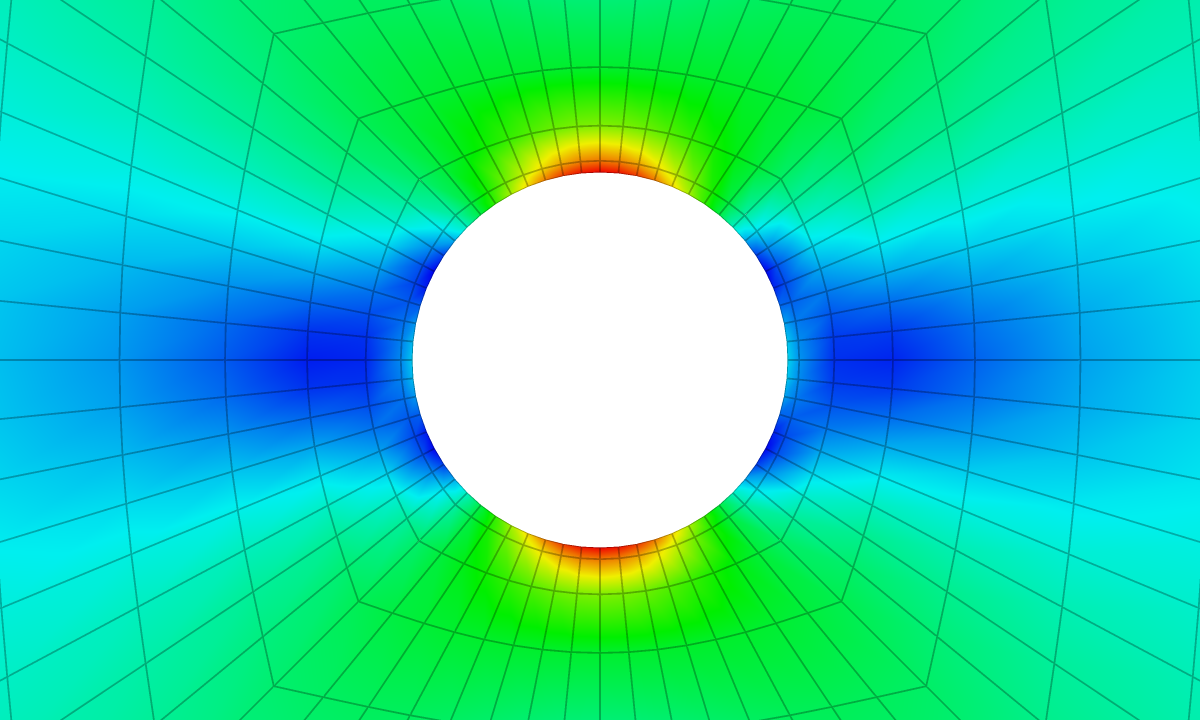
| Reference | KoFEM | Difference |
|---|---|---|
| 3.0000 | 2.7750 | −7.50 % within ±15 % |
The problem
| 1000 mm | |
| 10000 mm | |
| 500 mm | |
| 210 GPa | |
| 0.3 | |
| 100 MPa |
| Supports | x = −b face fixed (Ux, Uy, Uz). |
|---|---|
| Load | σ·2b·t in +x as a force on the x = +b face. |
| Measured | Peak element-centre von Mises stress around the hole, divided by σ. |
Analytical solution
Take an infinite plate under uniaxial tension along , with a hole of radius . In polar coordinates about the hole centre, with measured from the load direction, Kirsch's solution of the plane elasticity problem gives the hoop stress
On the edge of the hole, , the radial and shear stresses vanish because the surface is free, and
This is largest at , the points A across the load direction, and the stress concentration factor is
At the edge is in compression, , although the plate is pulled. Along the transverse axis the stress decays quickly with the distance from the hole,
to at and at (figure, right). At the edge it falls steeply, .
The solution does not depend on Poisson's ratio, so it holds in plane stress and plane strain alike. A plate of finite half-width raises slightly; for , as here, by about 1 % (Peterson's), so is a good reference.
Finite element model
| Mesh | O-grid, 12 rings × 64 around the hole, 1 through t: 768 linear 8-node hexahedra (P1) |
|---|---|
| Unknowns | 1,664 nodes, 4,992 degrees of freedom |
| Material | Linear elastic, isotropic |
| Solver | KoFEM engine (MFEM), the WebAssembly build the app runs: engine-5ceb743373dd |
The O-grid has 12 rings of 64 elements, graded so the rings are thinnest at the hole, with one element through the thickness. KoFEM reports one von Mises stress per element, at its centre; the case takes the largest value in the ring around the hole and divides it by . At A the surface is free and the only stress is , so there the von Mises stress equals and its peak is .
Results
| Quantity | stress-concentration factor Kt |
|---|---|
| Reference | Kt = 3 (infinite plate) |
| KoFEM | 2.7750 |
| Difference | −7.50 % within ±15 % |
Discussion
KoFEM's differs from 3 by −7.50 %. Two effects meet here. First, the measured stress is not the stress at the edge but at the centre of the first element, a small distance away, where the stress has already started to fall. Kirsch's solution at that point, and , gives a von Mises stress of , 8.4 % below the peak. Even exact element stresses could not reach 3 with this measure.
Second, element stresses carry their own discretisation error. Stress comes from derivatives of the displacement field, so it converges more slowly than the displacement does; here it lands above the exact value at the element centre. The published 2.77 is the net of both. That is why this case has a wider ±15 % band. Treat it as a check that the peak is in the right place and of the right size. To resolve a peak stress in a design, refine the mesh at the stress raiser until the peak stops changing.
Reproduce
In the app: open the model, then Studies → Static 1 → Run static solve, select the result plot and set Field to Ux. The Result summary shows Max Ux 9.688e+0 mm.
From a clone (Node.js 20+, bash, curl), this solves the model with the same engine and prints its line:
git clone https://github.com/mkofler96/KoFEM.git && cd KoFEM
bash scripts/fetch-wasm-engine.sh
node examples/validation/run.mjs --case plate-with-hole
Case Quantity FE Reference Err% Tol% Status
Plate with a hole stress-concentration factor Kt 2.7750 3.0000 -7.50 15 PASSReferences
- G. Kirsch, “Die Theorie der Elastizität und die Bedürfnisse der Festigkeitslehre”, Zeitschrift des Vereines deutscher Ingenieure 42 (1898) 797–807.
- S. P. Timoshenko and J. N. Goodier, Theory of Elasticity, 3rd ed., McGraw-Hill, 1970.
- W. D. Pilkey and D. F. Pilkey, Peterson’s Stress Concentration Factors, 3rd ed., Wiley, 2008.
KoFEM is research software and is not certified for safety-critical design. It solves linear-static, linear-elastic problems. Check results that matter against your own references.